
The Integration Process
Where what you know becomes how you feel
Understanding yourself was step one — the books, the podcasts, maybe the therapy. This page is about the other part. The important bit: where what you know becomes how you feel.
What follows is the whole method, laid out openly. Nothing held back. You could take this map and work with it on your own, and some people do. Working with me is faster, and held. Either way, you should know exactly what the work is.
Six practices, one circle
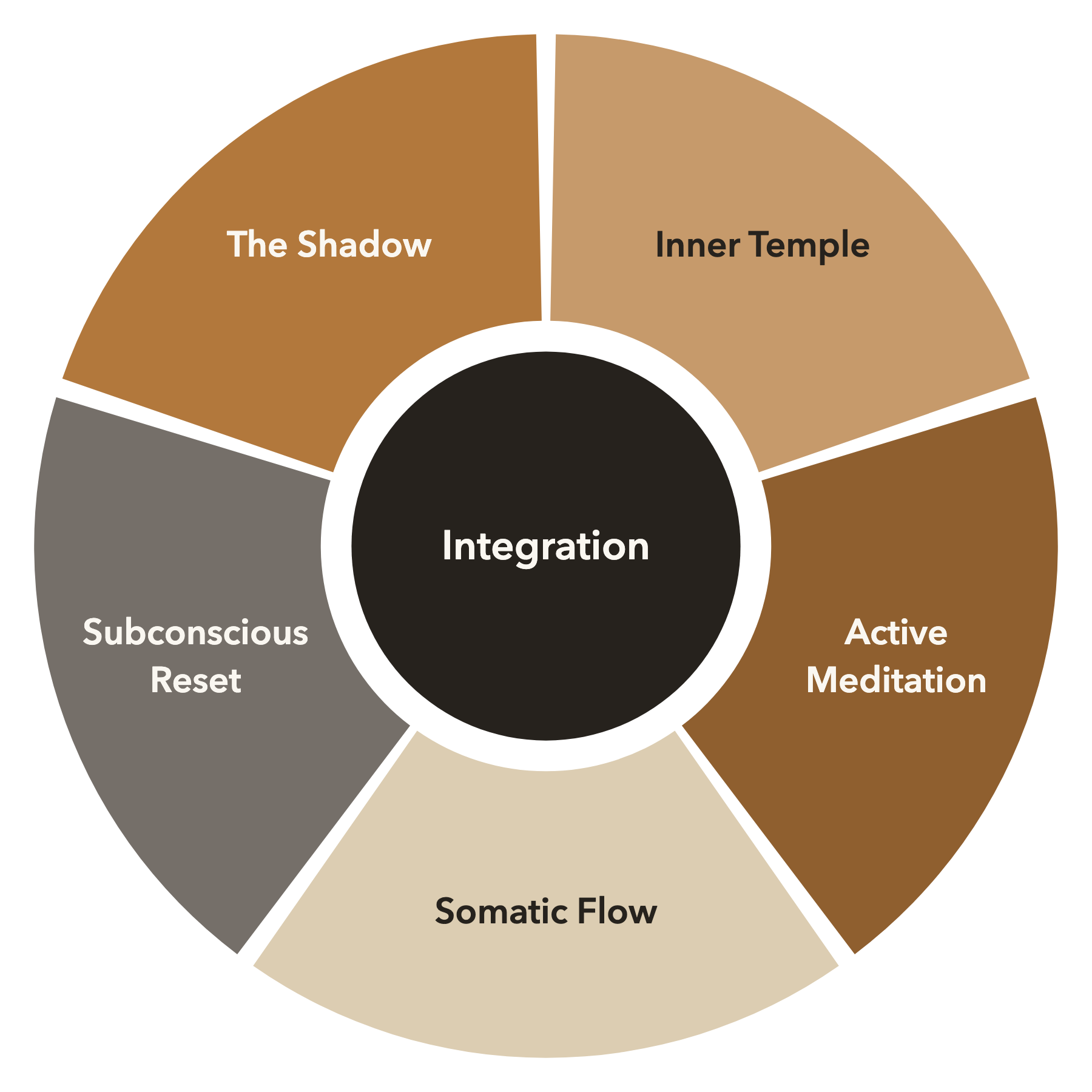
The Integration Process is built from six practices — Inner Temple, Active Meditation, Somatic Flow, Subconscious Reset, The Shadow, Integration — and they’re not steps to climb. They work together, all at once, in every session. Each time you come back to them, they take you a little deeper.
There’s one idea underneath all six: what hurt you doesn’t live in your thinking mind. It lives in your body. That’s why understanding it hasn’t moved it — you’ve been working on the right problem at the wrong level. These six practices work at the level where the problem actually lives.
Inner Temple — somewhere safe inside
Everything starts here. Using guided imagery, you build a place inside yourself that feels completely safe — somewhere you can stand, whatever is going on around you. Not a nice idea to think about: a place you can actually feel, and one that gets more solid every time you visit.
If you’ve spent years on alert, safety isn’t something your body takes on trust. It has to be experienced, a little at a time. That’s what this practice is for, and it’s why everything else rests on it.
What people notice first: closing your eyes starts to feel like relief instead of exposure.
Active Meditation — movement first, stillness later
If you’ve ever been told to sit still and empty your mind, and come away more agitated than you started, nothing was wrong with you. A wound-up body doesn’t relax on command. It needs somewhere for the energy to go.
Active Meditation pairs breath with easy, unhurried movement, so the restlessness has a way out before stillness is asked for. It’s also why I talk about journeys rather than meditations — you’re not left alone in silence watching your breath. You’re guided, the whole way.
What people notice first: the noise drops by itself, without forcing anything.
Somatic Flow — letting the body finish what it started
The jaw. The shoulders. The stomach. Your body has been holding on for years — braced through things it never got the chance to finish and let go of. Somatic Flow is slow, guided movement done in a deeply present state, giving all of that somewhere to move.
Sometimes what comes up is tears, or shaking, or laughter arriving out of nowhere. That isn’t something going wrong. That’s the holding finally moving — and it tends to make a strange kind of sense on the way out.
What people notice first: feeling lighter afterwards. Shoulders that come down on their own.
Subconscious Reset — changing the story underneath
Underneath the patterns you understand so well, there’s a story: I’m not good enough. It’s not safe to say no. Rest has to be earned. You didn’t choose it, and you can’t argue yourself out of it — you’ve tried. It lives beneath argument.
Subconscious Reset uses deep guided audio sessions to reach that story where it actually lives, and begin writing a different one. Repetition does the work; the sessions are built to help the mind drop deep enough for the new story to land.
What people notice first: catching the old story mid-sentence — and not entirely believing it anymore.
The Shadow — getting all of you back
Somewhere along the way, parts of you got pushed out of sight — the anger, the no, the wanting, the loudness, maybe the joy. Not because they were wrong, but because once upon a time they weren’t safe or welcome.
The Shadow is where we invite those parts back. This isn’t about fixing yourself. It’s about retrieving yourself. It’s the deepest of the six practices, and the one where being held in the work matters most — some doors open better with someone beside you.
What people notice first: feelings arriving without frightening them. Wanting things again.
Integration — the centre of the circle
This is why the whole process carries this name. Insights that stay in the practice room change nothing; the point is what holds on a Tuesday afternoon, at work, around your family.
Integration is where the changes get woven into ordinary life — small daily practices, and the slow discovery that you’re responding differently without trying to. My favourite measure of progress: the old reaction starts to look so out of proportion that you can’t take it seriously anymore.
What people notice first: they stop performing calm, and start just being ordinary.
What a session is actually like
Eyes closed, headphones in. A guided journey — you’re taken somewhere, not left to sit. Most sessions touch all six practices, some lightly, one or two deeply. Over weeks and months the circle turns, and the same ground gets covered a little deeper each time.
In practical terms, this is minutes a day and a session a week — not a life overhaul. And it isn’t a weekend fix. Things settle in layers, and some things come back around before they settle for good. That’s not failure. That’s how it actually works — and it’s why the change holds.
Who this is for
This work is for capable people who understand their patterns and are tired of only understanding them — people ready to show up and do something different with what they already know.
It isn’t for everyone. If you’re in crisis right now, this isn’t the right support — please reach out to a doctor or a crisis line today. And if you’re after something that fixes everything in a weekend, that isn’t me either.
Where this comes from
I spent twenty-five years as an engineer before this, so everything here had to earn its place — through my own recovery first, then a decade of using it with the people I work with. What didn’t work got dropped. What’s left is the process.
Ready to talk?
If you recognise yourself here, let’s talk. Book a short discovery call — no pressure, no script — and we’ll work out together whether this is the right fit for you, and where the best place to start would be.
This is guided practice for wellbeing. It is not therapy or medical care. If you are in crisis, please reach out to a doctor or a crisis line in your location today.